
Clogged gutters are one of the most common causes of water damage to homes — foundation flooding, fascia rot, soffit damage, and basement leaks all trace back to gutters that can’t drain. But gutter cleaning doesn’t have to mean working from a tall ladder, which is one of the most common causes of serious home improvement injuries. There are several effective methods for cleaning gutters from the ground using extension tools, leaf blowers, wet/dry vacuums, and pressure washer attachments. This guide covers all the practical approaches for one-story and two-story gutters without climbing.
What You’ll Need
- Extension pole or telescoping wand
- Gutter cleaning attachment for hose (curved wand)
- Leaf blower with gutter cleaning kit (optional)
- Wet/dry shop vacuum with gutter attachment (optional)
- Pressure washer with gutter cleaning wand (optional)
- Garden hose with high-pressure nozzle
- Safety glasses and old clothes
- Tarp or tarps (to collect debris on the ground)
- Ladder stabilizer (if using a ladder for one-story)
Safety and Precautions
- Falls from ladders kill over 300 Americans annually and injure over 164,000 more. For two-story gutters, from-the-ground methods are strongly preferred over ladder climbing.
- Wear safety glasses. Gutter cleaning — especially with a blower or pressure washer — propels debris unpredictably. Eye protection is essential.
- Wear old clothes. Gutter debris is wet, decomposing organic material that’s messy and difficult to wash out of clothing.
- Check for wasps and hornets. Gutters on south-facing walls in warm climates are frequent nesting locations. Look into gutters from the ground before starting work. Treat any nests before cleaning.
- Don’t lean extension poles into power lines. Check for overhead electrical lines before extending any long pole near your gutters.
Method 1: Garden Hose with Curved Gutter Wand
The simplest and most widely available method uses a curved gutter cleaning attachment that connects to a standard garden hose. These attachments (available at hardware stores for $10–20) have a U-shaped tip that fits into the gutter and allows you to direct water from the ground.
- Attach the curved wand to your garden hose and turn on the water.
- Position the wand over the gutter from the ground — it hooks over the edge and directs water into the gutter channel.
- Walk along the house, flushing the gutter section by section toward the nearest downspout.
- Work systematically from the far end toward the downspout to push debris toward the drain rather than away from it.
- When debris reaches the downspout, increase pressure to flush it through and down.
Best for: One-story gutters, light debris loads, connecting downspout clogs. The stream isn’t powerful enough for heavy packed leaf loads on two-story gutters.
Method 2: Leaf Blower Gutter Cleaning Kit
Many leaf blowers accept gutter cleaning attachments — a curved tube that directs air into the gutter from below. These kits (Toro Gutter Cleaning Kit, Worx, Black + Decker) attach to the blower’s exhaust nozzle.
- Assemble the gutter attachment on your leaf blower per kit instructions.
- Position the curved end over the gutter edge.
- Turn on the blower and walk the length of the gutter, blowing leaves and debris out as you go.
- Work from the far end toward the downspout, pushing debris toward the drain.
- Lay tarps on the ground below before starting — leaf blowers scatter debris widely.
Best for: Dry leaf debris. Ineffective on wet, packed, or decomposed material. Very messy — expect debris to scatter significantly. Works well on one-story and can reach two-story gutters with some blowers.
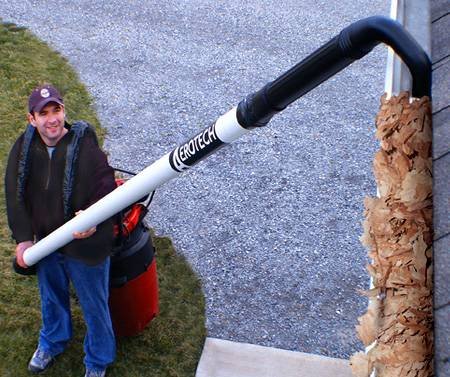
Method 3: Wet/Dry Vacuum with Gutter Kit
A shop vacuum with a gutter cleaning attachment offers the cleanest method — debris goes into the vacuum rather than scattering across the yard. RIDGID, Shop-Vac, and other brands offer gutter cleaning kits with curved attachments that connect to standard vacuum hoses.
- Assemble the gutter vacuum attachment per kit instructions.
- Position the curved end over the gutter from the ground.
- Vacuum the debris moving systematically along the gutter.
- Empty the vacuum frequently — wet leaf debris fills it quickly.
Best for: One-story gutters, any debris type, maximum cleanliness. Slower than other methods but leaves no mess on the ground. Requires frequent emptying. Good for homeowners who clean gutters themselves regularly.
Method 4: Pressure Washer with Gutter Cleaning Wand
A telescoping pressure washer gutter wand extends up to 20+ feet and can reach second-story gutters from the ground. The wand curves over the gutter edge and uses high-pressure water to blast debris toward the downspout.
- Attach the gutter cleaning wand to your pressure washer (typically a 40-degree tip).
- Extend the wand to the appropriate length for your gutter height.
- Position the wand tip into the gutter from one end.
- Apply water pressure while slowly walking toward the downspout end.
- Flush the downspout from below to clear it.
Best for: Both one-story and two-story gutters. Highly effective for packed debris. Very messy — sets up tarps before starting. This method is the most powerful for clearing heavily clogged gutters from the ground.
How to Clean Gutters With a Ladder (Safely)
If a ladder is needed for some reason, follow these safety rules:
- Use a stepladder for one-story gutters rather than an extension ladder when possible — stepladders provide more stable footing.
- Use a ladder stabilizer (standoff). This accessory attaches to the ladder and rests against the house fascia rather than the gutter, preventing gutter damage and making the ladder more stable.
- Never lean sideways from a ladder position. Move the ladder frequently rather than reaching. The primary cause of gutter-cleaning falls is overreaching.
- Have someone spot the ladder. A second person at the base dramatically reduces the chance of a ladder sliding or tipping.
- Use a gutter scoop to remove debris rather than your hand — gloves wear thin and hands encounter sharp edges in gutters.
How to Flush and Check Downspouts
After cleaning the gutter channels, always check downspout flow:

- Insert a garden hose into the top of the downspout and run full water pressure.
- Water should flow freely from the bottom. Slow or no flow indicates a clog inside the downspout.
- For downspout clogs, a plumber’s snake (drain auger) inserted from the top breaks up the blockage. Then flush with the hose again to clear.
- Check downspout extensions and ensure they direct water at least 3 feet away from the foundation.
Pro Tips for Gutter Maintenance
- Clean gutters twice annually — fall and spring. Fall after leaves drop is the most critical cleaning. Spring removes the debris and seedlings that accumulated over winter. In heavy tree areas, three or four times per year may be necessary.
- Consider gutter guards. Gutter guards (screens, micro-mesh, reverse-curve) significantly reduce how often gutters need cleaning. High-quality micro-mesh guards nearly eliminate the need for annual cleaning. Lower-cost screen guards still require occasional clearing but dramatically reduce debris volume.
- Inspect while you clean. Gutter cleaning is the best time to check for gutter sags, loose fasteners, and joint leaks. Use a garden hose to look for drips along seams after clearing.
- Mark downspout locations on the ground when working from the ground — it’s easy to lose track of where they are when you can’t see into the gutter.
Common Mistakes When Cleaning Gutters
- Cleaning without checking for nests first. Disturbing an active wasp or hornet nest from below or above is hazardous.
- Working from the ladder toward the downspout (wrong direction). Always work away from the downspout first, then flush toward it. Pushing debris away from the outlet means it has to travel farther and may reclog.
- Forgetting to clear the downspout. Clearing the gutter channel but not the downspout leaves the system only partially functional.
- Cleaning in the wrong season. Cleaning too early in fall before leaves have dropped means you’ll need to clean again. Wait until after your trees have fully dropped their leaves.
- Resting a ladder against the gutter. Gutters aren’t structural — resting a ladder against them bends and damages the gutter. Use a standoff attachment.
Frequently Asked Questions
Can I clean second-story gutters without a ladder?
Yes — a telescoping pressure washer wand, gutter vacuum kit with extension tubes, or an extended gutter cleaning wand for a garden hose can all reach second-story gutters from the ground. For typical 20–25 foot gutter heights, these tools work effectively. For very high three-story gutters, professional gutter cleaning is the most practical and safe option.
How often should gutters be cleaned?
Twice annually — fall after leaf drop, spring for winter accumulation — is the standard recommendation. Homes under heavy tree coverage (pine needles, oak, maple) may need 3–4 cleanings per year. Gutter guards can extend the interval to 3–5 years between cleanings for high-quality systems.
What’s the fastest way to clean gutters?
The fastest DIY method is the leaf blower with gutter kit, which clears a length of gutter in minutes. It’s messy but quick. The pressure washer wand is also very fast for stubborn debris. Manual cleaning from a ladder with a gutter scoop is thorough but slow.
How do I know if my gutters need cleaning?
During or after rain, look for: water overflowing the sides of the gutter, water not coming out of downspouts, visible plants or debris above the gutter line, staining on the siding below the gutter, and pooling water near the foundation. Any of these indicate clogged or improperly draining gutters.
Is gutter cleaning something I should hire out?
For one-story homes, gutter cleaning is one of the most DIY-friendly home maintenance tasks. For two-story homes, a from-the-ground extension tool is a reasonable DIY approach. For three-story homes or homes with difficult roof access, professional gutter cleaning ($75–200 for most homes) is a good value for the safety tradeoff.
Conclusion
You don’t have to risk a ladder fall to maintain clean gutters. From-the-ground tools — curved garden hose attachments, pressure washer wands, shop vacuum kits, and leaf blower attachments — handle gutter cleaning safely and effectively for most one-story and two-story homes. Clean twice annually, clear the downspouts every time, and consider gutter guards to reduce how often the task needs to be done. Clean gutters prevent some of the most expensive water damage that homes experience.
For related exterior home maintenance guides, see our articles on how to clean aluminum siding and how to clean a wood fence. For cleaning the ground-level perimeter near your home, our concrete steps cleaning guide covers the entry area maintenance.
