
Staining a fiberglass door is different from staining real wood — fiberglass doesn’t absorb stain the way wood does, so the process involves applying the stain as a surface coat, working it into the textured grain of the door, and sealing it with a protective topcoat. Done correctly, a stained fiberglass door is nearly indistinguishable from real wood and far more resistant to weather, warping, and rot. This guide walks through surface preparation, stain application, graining technique, and topcoat sealing.
What You’ll Need
| Tools | Materials |
|---|---|
| Foam brush or lint-free rag | Gel stain (designed for fiberglass doors — e.g., Minwax Gel Stain) |
| Dry bristle brush or graining tool | Pre-stain conditioner (optional but recommended) |
| Tack cloth | Exterior polyurethane or spar varnish (for topcoat) |
| Painter’s tape | Fine sandpaper (220-grit) |
| Clean rags | Mineral spirits or acetone (for cleanup) |
| Drop cloth | Mild soap and water (for cleaning) |
Safety and Precautions
- Work in a shaded, well-ventilated area. Apply stain and topcoat out of direct sunlight — sunlight accelerates drying and causes lap marks. A cool, shaded day (50–80°F) gives the most working time and the most even results.
- Dispose of stain-soaked rags properly. Rags soaked with oil-based gel stain or mineral spirits can self-ignite through oxidation if left in a pile. Spread them flat to dry outdoors, or store in a sealed metal container with water.
- Wear nitrile gloves. Gel stain penetrates skin and is very difficult to remove. Gloves are the practical choice throughout the application process.
Step 1: Prepare the Door Surface
Clean and Sand — This Determines the Final Look
- Remove the door from its hinges and lay it flat on sawhorses if possible. Staining horizontally eliminates drips and runs.
- Remove all hardware: hinges (or mask them with painter’s tape), door handle, knockers, address numbers.
- Wash the door surface with a solution of mild soap and water. Use a soft cloth — not a scrubber. Rinse with clean water and allow to dry completely (at least 2 hours in warm weather).
- Lightly sand the entire door surface with 220-grit sandpaper. On fiberglass, this light sanding removes any factory surface treatment or UV coating that would prevent stain adhesion. The goal is a uniform matte surface — you’ll feel the texture even out under your hand.
- Wipe the entire surface with a tack cloth to remove all sanding dust. Any dust left on the surface will show through the stain as specks or bumps.
Step 2: Apply Pre-Stain Conditioner (Recommended)
Helps Achieve a More Even Stain Color Across the Door
- Apply a thin, even coat of pre-stain conditioner (also called fiberglass pre-stain) to the door with a foam brush or lint-free rag.
- Work it into the grain texture with the brush, then wipe any excess off with a clean rag. The conditioner should be a thin, even coat — not pooled.
- Allow the conditioner to dry completely per the product label (usually 15–30 minutes) before applying stain.
- Pre-stain conditioner isn’t strictly required, but it helps even out color absorption across the fiberglass texture and produces a more consistent final appearance.
Step 3: Apply the First Coat of Gel Stain
Work in Sections — Top to Bottom, Panel by Panel
Gel stain is the right product for fiberglass doors because its thick consistency stays on the surface rather than beading off. Wiping stain or liquid stain does not work well on fiberglass.
- Stir the gel stain thoroughly before opening the lid’s seal, and stir again before each use. Gel stain can settle and become uneven if not properly mixed.
- Apply gel stain with a foam brush or lint-free rag in the direction of the grain texture. Work in one panel section at a time — don’t try to stain the entire door in one pass before wiping.
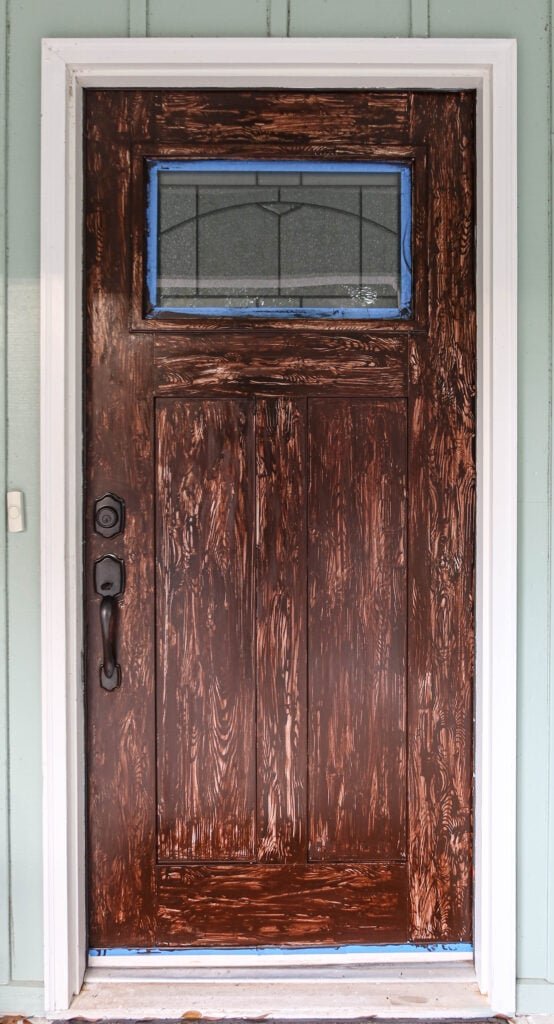
- Work stain into the texture grooves using a bristle brush with a light touch. This brings out the grain look that makes a fiberglass door resemble real wood.
- While the stain is still wet, wipe off the excess with a clean lint-free rag, using long strokes in the direction of the grain. How much you wipe off determines the depth of color — leaving more gives darker color, wiping aggressively gives lighter color.
- Check for drips, runs, or uneven areas and wipe out immediately while the stain is wet. Once dry, these are very difficult to fix.
- Allow the first coat to dry completely — at minimum 8 hours, ideally overnight.
Step 4: Apply a Second Coat for Depth

Most Doors Need Two Stain Coats for a Rich Color
- Lightly scuff the dried first coat with 320-grit sandpaper or fine steel wool (#0000). This removes any dust nibs and gives the second coat something to grip.
- Wipe with a tack cloth to remove all dust.
- Apply the second coat using the same technique as the first. You can deepen or vary the color by adjusting how much stain you leave on the surface before wiping.
- For a more realistic wood look: while the second coat is still slightly tacky (not fully wet, not dry), drag a dry bristle brush lightly in the grain direction. This creates the subtle variation and light streak patterns visible in real wood grain.
- Allow the second coat to dry fully before applying the topcoat — minimum 24 hours.
Step 5: Apply the Clear Topcoat
Exterior Polyurethane or Spar Varnish — This Protects Everything
The topcoat is the critical protective layer that keeps the stain from wearing, fading, and peeling. Without it, the gel stain will fail within one season on an exterior door.
- Choose an exterior-grade topcoat: spar urethane or spar varnish are the most UV- and moisture-resistant options for exterior use. Water-based exterior polyurethane also works but typically requires more coats.
- Apply the topcoat with a quality foam brush or a natural bristle brush, using long strokes in the grain direction. Avoid overworking the wet topcoat — lay it on and leave it.
- Apply at least two coats, lightly sanding with 320-grit between coats (sand when fully dry, then tack cloth).
- Three coats is the minimum for exterior doors with direct weather exposure. The final coat should not be sanded — leave it as the finished surface.
- Allow the final coat to cure fully (usually 24–48 hours) before rehaning the door and replacing hardware.
Pro Tips and Common Mistakes
- Use gel stain, not wiping stain or liquid stain. Liquid stains bead off fiberglass or dry to an uneven, blotchy surface. Gel stain’s consistency is designed to stay on non-porous surfaces and produce the wood-look result.
- Work in small sections and wipe while wet. Gel stain dries faster in warm weather. If you apply it to the whole door before wiping, the first sections will have dried unevenly. Work in one panel at a time: apply, work in, wipe off.
- Don’t stain in direct sun. Sunlight dries stain before you can properly work it in or wipe it off evenly. Work in shade or on an overcast day.
- The topcoat must be exterior grade. Interior polyurethane breaks down rapidly when exposed to UV and moisture. Always use spar urethane or another specifically exterior-rated product on an outside door.
Troubleshooting
| Problem | Likely Cause | Fix |
|---|---|---|
| Stain looks blotchy or uneven | Stain applied to unsanded surface or dried unevenly | Sand smooth, apply pre-stain conditioner, reapply stain evenly |
| Stain won’t stick — beads off surface | Surface not sanded or factory coating not removed | Sand more aggressively (150-grit then 220-grit), wipe clean, restain |
| Color too dark after first coat | Stain left on too long before wiping | Apply a second coat and wipe very aggressively immediately to lighten; allow to dry fully |
| Topcoat peeling within one season | Interior polyurethane used; or stain not fully dry before topcoat | Strip and refinish with exterior-grade spar urethane |
| Drips or runs in topcoat | Applied too thick | Sand runs flat when dry, apply thin additional coat |
Frequently Asked Questions
Can you use regular wood stain on a fiberglass door?
Standard penetrating wood stains (wiping stains, liquid stains) don’t work well on fiberglass because fiberglass is non-porous — the stain beads off or dries blotchy without penetrating. Gel stain is the correct product: its thicker consistency stays on the surface and can be worked into the texture grain for a realistic wood appearance.
How long does a stain job on a fiberglass door last?
With proper prep and a quality exterior spar urethane topcoat, a stained fiberglass door finish lasts 3–5 years before needing a fresh topcoat. The topcoat is what actually weathers — the stain beneath stays intact. Reapplying a topcoat coat (light sand plus 1–2 fresh coats) every few years maintains the appearance without a full restain.
What is the best stain color for a fiberglass door?
That depends on the wood species you’re simulating. Medium to darker gel stains (walnut, mahogany, golden oak, dark walnut) produce the most realistic wood-look result on fiberglass because they provide enough contrast to show the grain texture. Very light stains (like golden pecan) can look flat on fiberglass because the grain contrast is minimal.
Do I need to sand a fiberglass door before staining?
Yes — 220-grit sanding is required to remove the factory surface coating and provide tooth for the stain to adhere to. Without sanding, gel stain may peel or not adhere evenly. The sanding should be light and uniform — the goal is a consistent matte surface, not shaping or reshaping the door.
Can I re-stain a fiberglass door without stripping the old finish?
If the existing finish is intact (no peeling, cracking, or chipping), you can lightly sand (320-grit), wipe clean, and apply fresh stain and topcoat over the existing finish. If the old finish is peeling or failing, it must be stripped first — use a chemical stripper or sand it off completely down to the bare fiberglass surface before restaining.
Conclusion
Staining a fiberglass door is a two-day project that transforms a plain door into a realistic wood-look focal point at the front of a home. The critical variables are: sand the surface before starting, use gel stain (not liquid stain), work panel by panel and wipe while wet, and finish with at least three coats of exterior-grade spar urethane. Skip the topcoat or use an interior product and the finish will fail within a season.
Once your door is finished, keep it sealed and protected for years. Our guide on how to seal and weatherproof a door covers the weatherstripping and door sweep work that protects the door against moisture from the outside, which is the primary enemy of any door finish over time. And if you’re also looking to clean and maintain a metal door in addition to the fiberglass, our guide on how to clean a metal door covers the complementary process for steel and aluminum doors.
